A cross-chain swap can become more expensive when the token price barely moves. That sounds backwards, but the reason is simple: the cost is not determined by one transaction alone. A user may pay for an approval, a swap, a bridge message, a destination-chain transaction, and sometimes a second swap before the assets are usable. The most important gas-saving decision therefore happens before clicking “confirm.” It is choosing the right route, chain, timing, and transaction sequence.
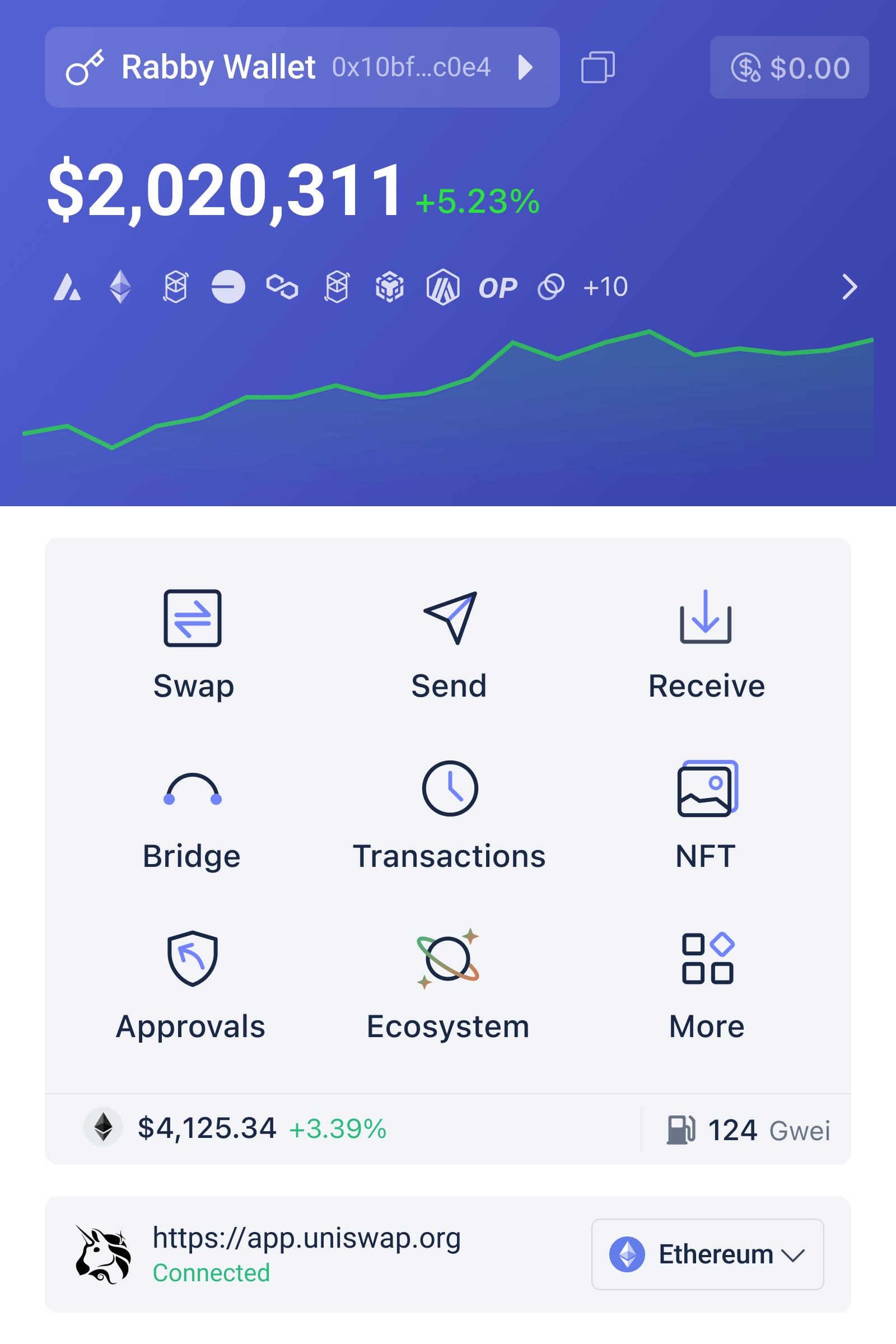
Consider a US-based DeFi user who holds a stablecoin on one EVM network and wants to provide liquidity on another. The user may describe the task as “swap USDC for ETH,” but operationally it could involve several different actions. A wallet is not merely a balance display in this situation; it is the interface through which the user interprets permissions, network changes, fees, contract calls, and final settlement. That is where a tool such as Rabby can be useful—not because it makes blockchain costs disappear, but because clearer transaction context can help users avoid expensive mistakes.
The case: a “cheap” route with four separate costs
Suppose Alex has a dollar-pegged asset on Chain A and wants the native gas token on Chain B to interact with a lending protocol. Alex sees a route advertised with a low swap fee. That headline number is only one part of the transaction’s economics. The route may require approval on Chain A, an on-chain swap there, a bridge transaction, and a destination-side action. If Alex arrives on Chain B without enough of its native token to pay for the final interaction, the assets may technically have arrived while remaining practically stranded.
This is the first common myth: a cross-chain swap is one trade. In many cases, it is better understood as a small supply chain. One component moves value, another communicates a message between networks, and another may exchange the received asset into the form required by the destination application. Each component has its own failure modes, pricing, and timing. A wallet can help present the transaction sequence, but it cannot eliminate the underlying contracts or guarantee that every route will be available at every moment.
The second myth is that the cheapest gas price produces the cheapest transaction. Gas price is only the price paid per unit of computation. Total network cost also depends on how much computation the call uses, whether an approval is needed, how many contracts are involved, and whether the route requires multiple networks. A high-fee chain can sometimes be economical for a single, efficient action, while a low-fee chain can become costly if the route adds several calls, failed attempts, or corrective transfers.
For Alex, the meaningful question is not “Which chain is cheapest?” It is “What is the least expensive reliable path from my current asset and network to the action I actually need to perform?” That distinction is subtle but powerful. A route that saves a small amount of gas while adding material slippage, bridge risk, or operational complexity may be worse for the user’s total outcome.
How gas optimization works in a cross-chain setting
Gas optimization begins with decomposition. Before approving anything, identify the likely steps: token approval, source-chain swap, bridge or cross-chain transfer, destination-chain swap, and final protocol interaction. Some routes combine steps through a router, but combining them does not mean they become free. It usually means the user is delegating more logic to a contract call. The call may be convenient, yet it can also be harder to inspect and may consume more gas than a simpler sequence.
One practical rule is to compare the complete route, not the visible swap fee. Add the source-chain network fee, any approval cost, bridge fee, destination-chain gas, expected price impact, and the value of time spent waiting or retrying. For small transactions, a fixed bridge charge or a destination-side gas requirement can dominate the economics. For large transactions, slippage and execution quality may matter more than a modest difference in gas.
Timing also matters, although it should not be confused with prediction. Network congestion can change the fee required for prompt inclusion. If an action is not time-sensitive, a user may choose to wait for less competition. If the position is exposed to price movement, however, delaying to save gas can create a larger market risk than the fee being saved. The correct decision depends on the asset, the size of the trade, and the urgency of the destination action.
Transaction batching presents another trade-off. A router or application may combine approval and execution, or bundle several operations into one call. This can reduce repeated wallet interactions and sometimes reduce overhead. But a larger call may be more difficult to understand, and if it fails, the user may need to diagnose a more complicated transaction. “Fewer clicks” and “lower total cost” are related possibilities, not synonyms.
What Rabby adds—and what it cannot promise
For users considering the Rabby browser extension, the practical value is transaction awareness. A wallet interface can help users review which network is active, which asset is being spent, which contracts are being called, and what permissions are being requested before signing. That review is especially important in cross-chain activity, where a familiar token symbol may appear on multiple networks but represent different contract addresses and different liquidity conditions.
Users who want to evaluate the extension can begin with the rabby extension download and install it through a supported browser workflow. The security principle is more important than the installation step itself: verify the software source, keep the recovery phrase offline, and treat every approval as an authorization with consequences. A wallet can improve visibility, but it cannot protect a user who signs an unfamiliar contract call without reviewing it.
Recent Rabby project messaging has positioned the wallet as a tool for Ethereum and EVM networks, with emphasis on broad on-chain use and browser support such as Chrome and Brave. That context fits the cross-chain problem because many DeFi routes move between EVM-compatible environments. Compatibility, however, should not be mistaken for identical behavior. EVM chains can differ in native gas tokens, fee markets, finality assumptions, bridge support, liquidity depth, and the way applications implement permissions.
There is also a boundary condition that wallet interfaces cannot solve: bridge risk. A bridge or cross-chain messaging system is an independent layer with its own contracts, validators, relayers, or verification design. If that layer is congested, paused, exploited, or simply incompatible with the chosen asset, a wallet may display the interaction clearly while the economic risk remains. Better visibility is valuable; it is not a guarantee of protocol safety or successful settlement.
Myths that make cross-chain transactions expensive
Myth: a token’s name tells you where it can be used
Reality: the network and contract address are part of the asset’s identity. A stablecoin on one chain is not automatically interchangeable with a similarly named token on another. Before signing, confirm the source asset, destination asset, and the application’s accepted version. Confusion here can lead to failed deposits, unwanted conversions, or a need for another bridge transaction.
Myth: unlimited approvals are always more efficient
Reality: an unlimited approval may avoid repeating an approval transaction, but it grants a contract broader spending authority than a transaction-sized approval. The gas saved later must be weighed against the permission’s duration and scope. A user who frequently interacts with a trusted application may make a different choice from someone testing an unfamiliar protocol. The correct answer is a risk decision, not a universal optimization rule.
Myth: a failed transaction always loses the entire amount
Reality: a reverted transaction generally does not complete the intended state change, but the network may still charge gas for the computation that was attempted. Cross-chain flows add another complication: a source-side action may succeed while a later destination-side action requires attention. Users should distinguish between an unsuccessful transaction, a pending message, and assets that have arrived but are not yet usable.
Myth: the fastest route is the safest route
Reality: speed can be useful, but urgency can encourage users to skip contract review, accept excessive slippage, or choose a route with thin liquidity. A fast transaction is not necessarily a well-priced transaction. For meaningful amounts, a short delay to inspect the route and confirm the destination network may be a more rational form of optimization than chasing the lowest displayed fee.
A reusable checklist for lower-cost, lower-surprise swaps
Start with the destination objective. Are you trying to hold an asset, trade it, deposit it into a protocol, or obtain gas for another transaction? The answer determines whether a direct bridge, a swap-then-bridge route, or a destination-side conversion makes sense. Then check whether you already hold enough native gas token on both networks. A small reserve can prevent a stranded balance, but keeping excessive idle tokens on many chains creates its own management burden.
Next, inspect the entire route and separate its costs. Look for approvals, network fees, bridge charges, price impact, slippage limits, and the expected number of destination transactions. Review the spender and the contract interaction rather than relying only on the token symbol or a prominent “best route” label. If the route is unusually complex, test with a small amount first. A test does not prove that a protocol is safe, but it can reveal address, network, and operational errors before the full amount is exposed.
Finally, decide what kind of uncertainty you are accepting. You may be trading fee uncertainty for bridge delay, price uncertainty for a lower gas price, or contract risk for convenience. Writing that trade-off down mentally is useful because it prevents a narrow metric—usually gas—from dominating the decision. The cheapest route is often the one that avoids a second transaction caused by the first transaction being poorly planned.
What to watch next
If wallets continue expanding across EVM networks, the most useful improvements may be less about adding another swap button and more about improving route comprehension. Users need interfaces that show the full economic path: where assets begin, where they are converted, which permissions are created, what fees are paid on each network, and what must happen before the funds can be used. Conditional routing could become more valuable if it clearly distinguishes a genuinely cheaper path from one that merely shifts cost to the destination.
The unresolved issue is whether greater abstraction will improve safety or encourage users to sign transactions they no longer understand. Better automation can reduce clerical mistakes, but it can also hide complexity. The strongest wallet experience will therefore combine convenience with inspectability: simple for routine actions, explicit when permissions, bridges, unfamiliar contracts, or unusual slippage are involved.
Frequently asked questions
Can Rabby reduce the gas fee of a cross-chain swap?
A wallet does not control the network’s base fee, bridge pricing, liquidity, or the computation required by a contract. Rabby may help users understand and compare the transaction path, choose an appropriate network, and avoid unnecessary or mistaken actions. Those decisions can reduce total cost in some situations, but savings are conditional rather than guaranteed.
Why do I need gas on the destination chain?
Receiving an asset and using it are separate events. A bridge may deliver tokens to the destination address, but a later swap, approval, lending deposit, or withdrawal still requires that network’s native gas token. Planning for the next action—not just the arrival of funds—is one of the most overlooked parts of cross-chain execution.
What is the safest way to try a new cross-chain route?
Verify the network and token addresses, inspect the contracts and permissions, check the complete fee path, and begin with an amount small enough to tolerate a delay or operational error. Keep the recovery phrase offline and never approve a transaction solely because the interface presents it as the fastest or cheapest option.
Cross-chain gas optimization is not a hunt for a magic low-fee setting. It is a planning discipline: define the destination action, map every step, price the full route, and understand which risks are being exchanged for convenience. A wallet such as Rabby can make that reasoning more visible across Ethereum and EVM networks. The final judgment still belongs to the user—and that is precisely why clear transaction context matters.